
Example Outputs
Real reports generated from real datasets — including the focus question, generated chart, chat refinements, and downloadable PDF.
Jump to an example
Tap or click to scroll directly to that showcase.
Foods Health Scores & Allergens
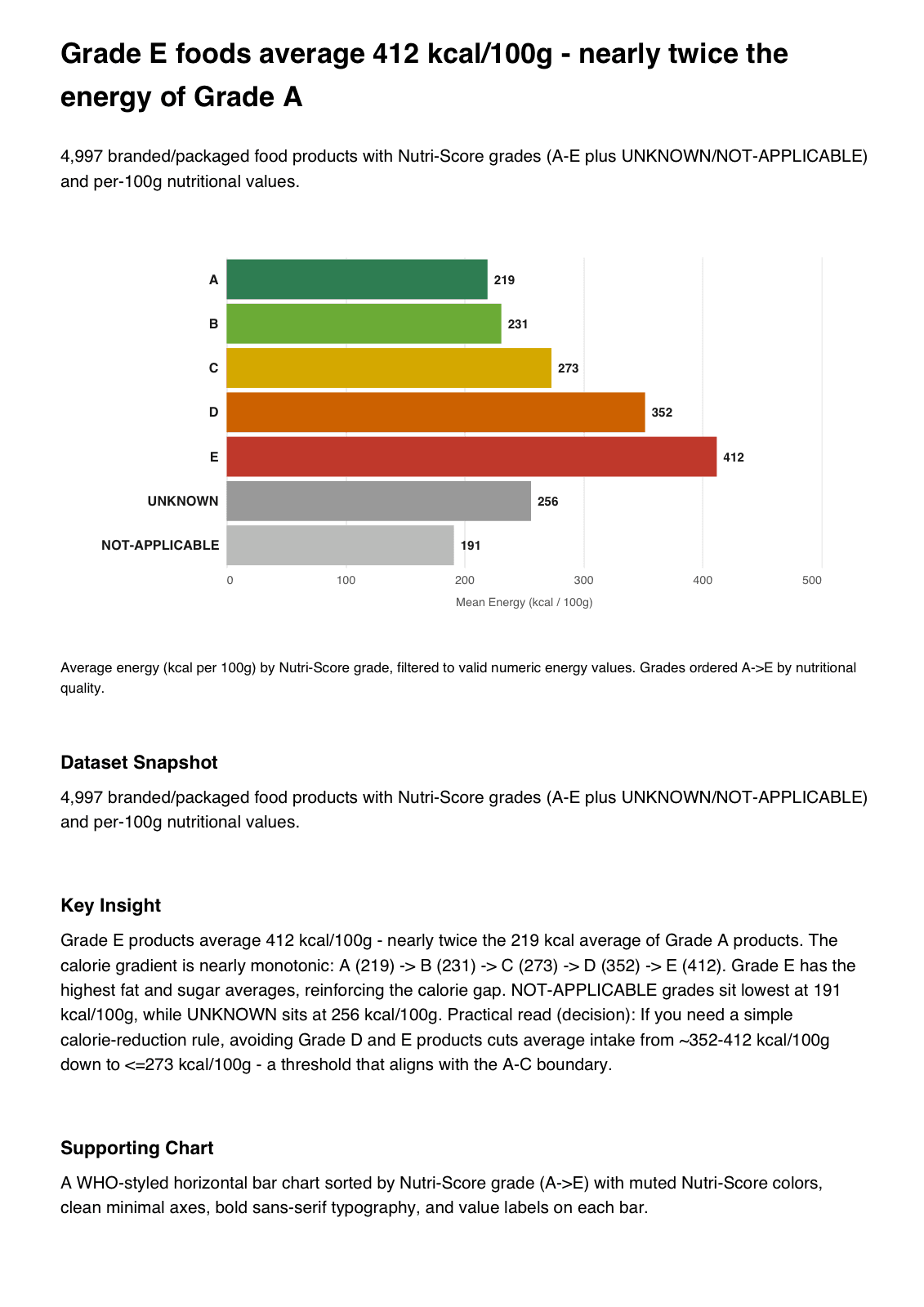
Grade E products average 412 kcal/100g, nearly twice the energy of Grade A foods at 219 kcal/100g.
Meteor Strikes
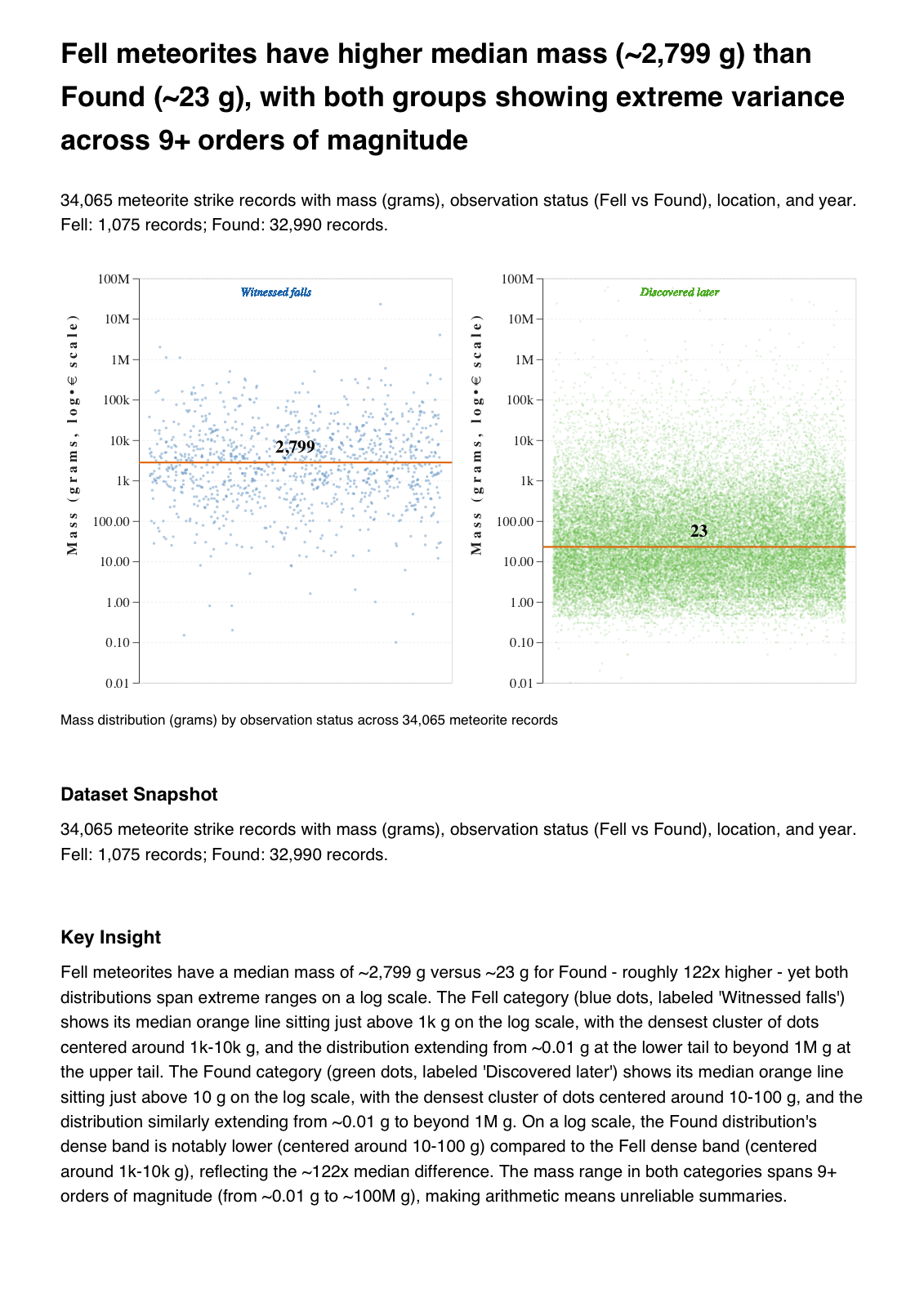
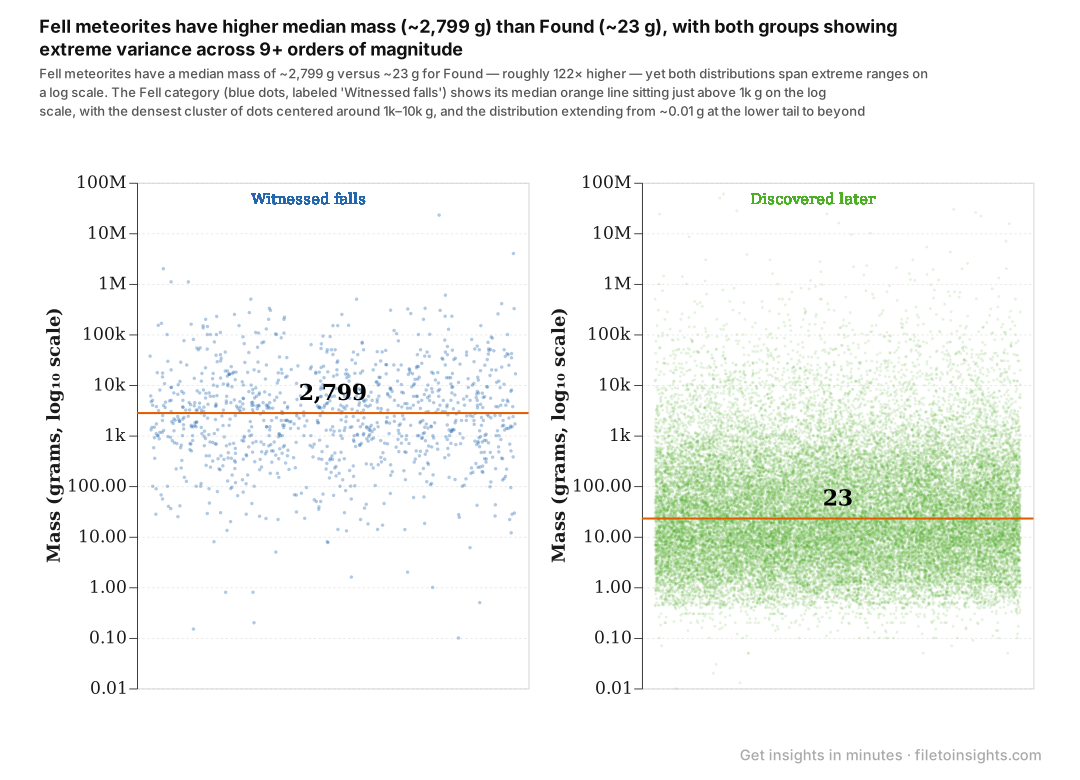
Fell meteorites have a far higher median mass (~2,799 g) than Found (~23 g), even though both span 9+ orders of magnitude.
Iris Flower Clusters
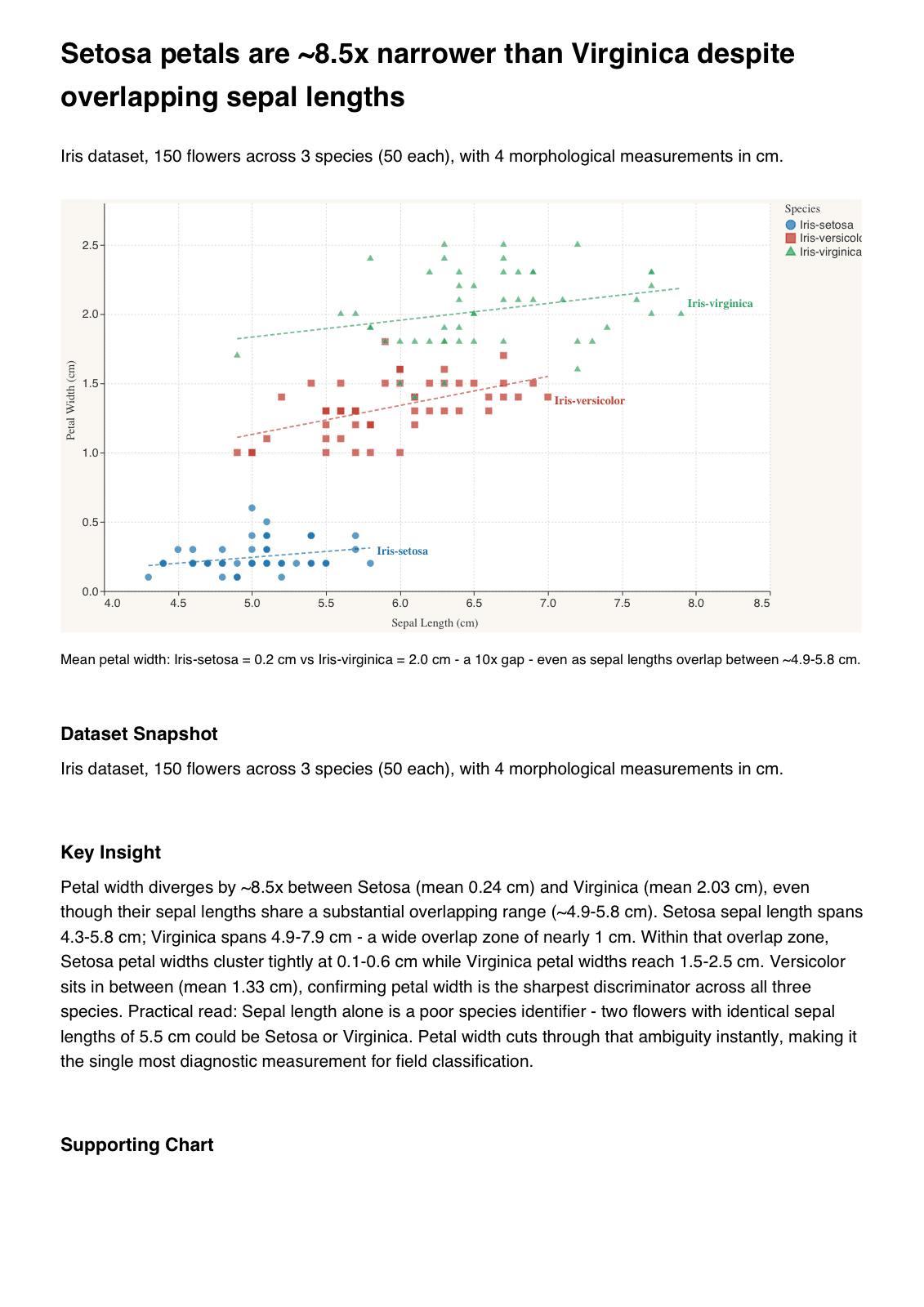
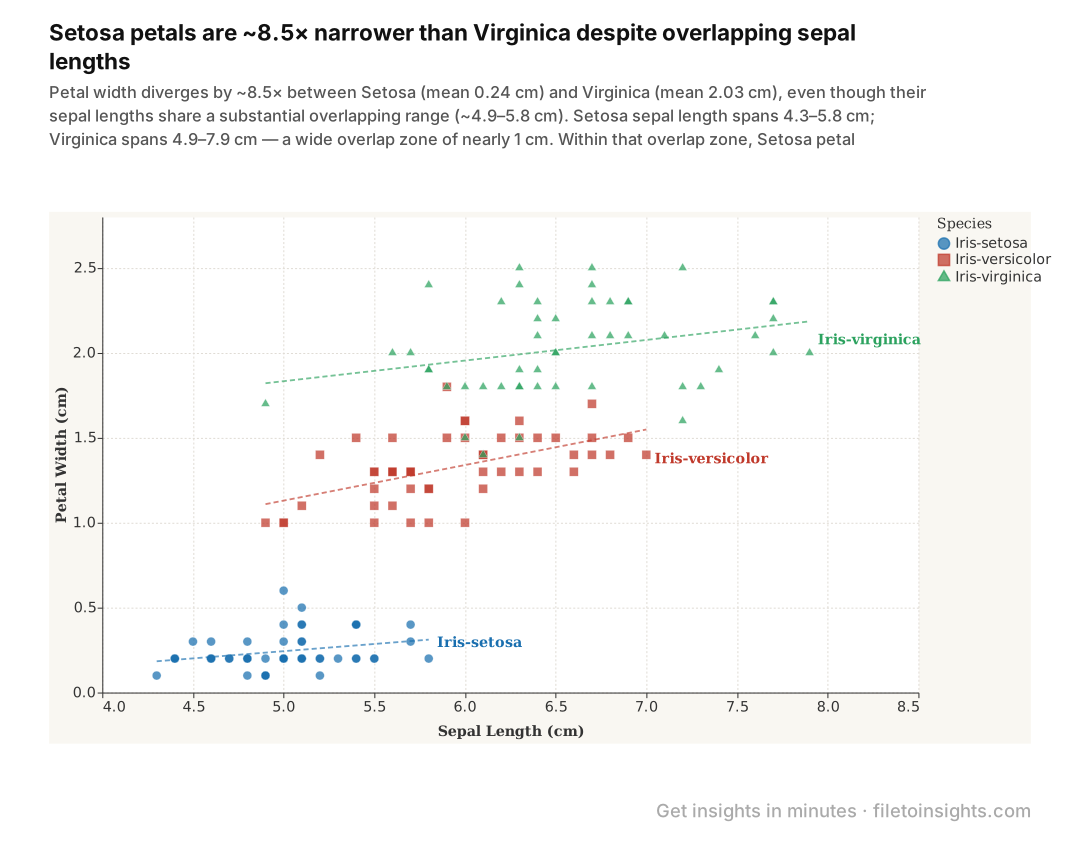
Setosa petals are ~8.5x narrower than Virginica despite overlapping sepal lengths.
What do the modes mean?
Compare groups, support a call.
Distributions, correlations, outliers.
One dramatic, shareable narrative.
Example 1: Foods Health Scores & Allergens
DecisionGrade E products average 412 kcal/100g, nearly twice the energy of Grade A foods at 219 kcal/100g.
Focus Question
“Which nutriscore_grade category has the highest average energy_kcal content?”
Generated Chart
Key Insight
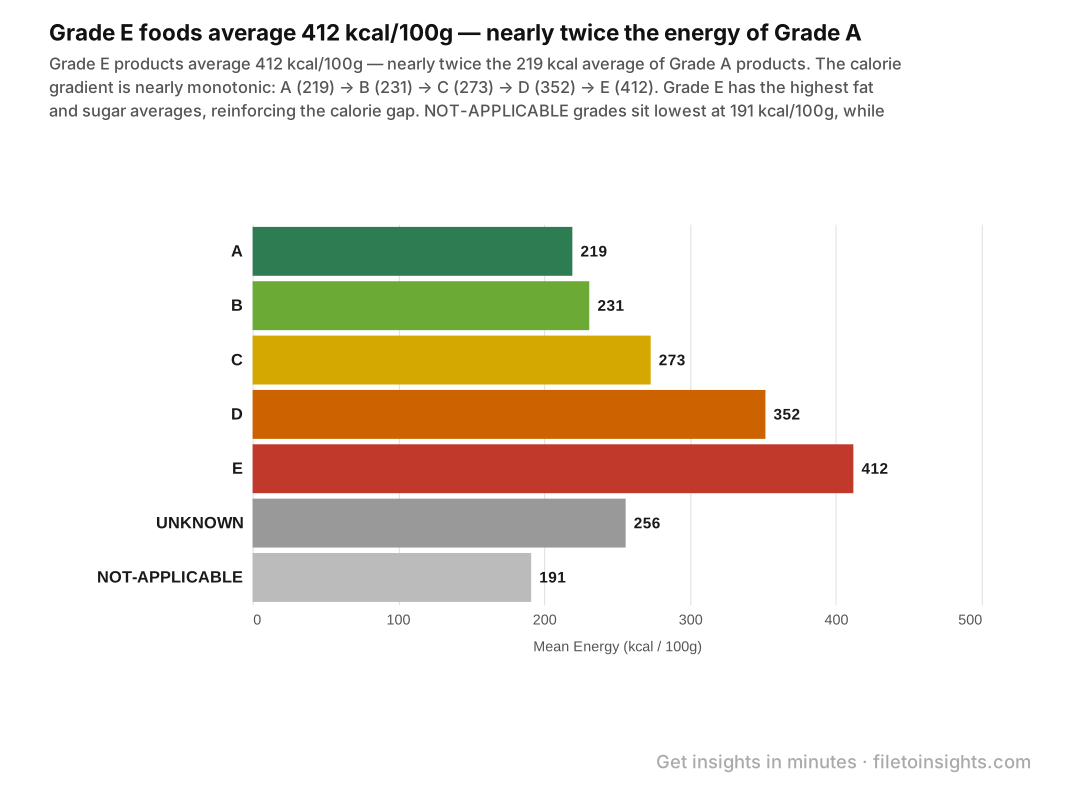
Grade E has the highest average energy at 412 kcal/100g. The climb from A (219) to E (412) is close to monotonic, so avoiding Grades D and E is a simple rule if the goal is lower calorie density.
Dataset
4,997 branded/packaged food products with Nutri-Score grades (A-E plus UNKNOWN/NOT-APPLICABLE) and per-100g nutritional values
Health & Nutrition
Explorations made
Initial energy comparison
Confirmed Grade E as highest at ~412 kcal/100g and excluded impossible energy outliers with a 900 kcal cap
Clean baseline chart
Added annotations for Grade A and Grade E, dimmed the middle grades, and showed the 193 kcal/100g gap with a bracket
Dense annotations
Removed extra bar labels, filtered out null labels, and kept only one dashed line for Grade A
Endpoint labels
Changed the left label to 'Grade A' and simplified the right label to '412'
Annotated comparison variant
Reset the chart to its original clean state with all bar labels restored
Chart description
Horizontal bar chart of mean energy (kcal/100g) by Nutri-Score grade, using the Nutri-Score palette and value labels on each bar.
Example 2: Meteor Strikes
Deep DiveFell meteorites have a far higher median mass (~2,799 g) than Found (~23 g), even though both span 9+ orders of magnitude.
Focus Question
“How does mass_g distribution vary by fell_found status, and which category shows greater variance?”
Generated Chart
Key Insight
Fell meteorites have a much higher median mass at ~2,799 g versus ~23 g for Found. Both groups span extreme ranges from roughly 0.01 g to 100M g, so the main separation is their center of mass on the log scale, with Found concentrated much lower.
Dataset
34,065 meteorite strike records with mass (grams), observation status (Fell vs Found), location, and year
Earth Science / Astronomy
Explorations made
Log-scale box plot
Violin chart — surfaced the full mass density instead of only quartiles
Single violin chart
Two side-by-side Fell and Found panels with a shared log-scale y-axis
Wide violins and light labels
Narrowed the violins, enlarged the median markers and labels, and switched label text to black
Default styling
Scientific American editorial treatment with Georgia serif type, muted fills, and light dashed grids
Violin panels
Jittered dot plots with the median retained, then widened jitter to full panel width and reduced the orange rule weight
Chart description
Two side-by-side jittered dot plots on a shared log10 mass axis, with full-width spread in each panel and a thin orange median rule for Fell and Found.
Example 3: Iris Flower Clusters
StorySetosa petals are ~8.5x narrower than Virginica despite overlapping sepal lengths.
Focus Question
“Despite similar sepallengthcm ranges, how drastically does petalwidthcm differ between Iris-setosa and Iris-virginica?”
Generated Chart
Key Insight
Petal width diverges by ~8.5x between Setosa (mean 0.24 cm) and Virginica (mean 2.03 cm), even though their sepal lengths share a substantial overlap around 4.9-5.8 cm. Petal width cuts through that ambiguity instantly, making it the most diagnostic single measurement for classification.
Dataset
Iris dataset, 150 flowers across 3 species (50 each), with 4 morphological measurements in cm
Biology / Classification
Explorations made
Tick-strip comparison
Scatterplot with sepal length on x and petal width on y so overlap and separation are visible together
Default styling
New York Times-inspired styling with warm paper background, Georgia serif fonts, muted gridlines, and editorial colors
Right-anchored Virginica label
Moved the Iris-virginica label to the left side of its cluster
Left-anchored Virginica label
Undid the move and restored all three species labels to a unified right-edge text layer
Chart description
Scatterplot of sepal length versus petal width for all 150 flowers, colored by species with dashed trend lines and species labels anchored at the right edge of each cluster.
Ready to turn your CSV into insights?
Start your free trial to upload your own file and export presentation-ready outputs.